
How Internship at NBD Shaped My Understanding of Climate Resilience and Community Action
Published: 13 February 2026
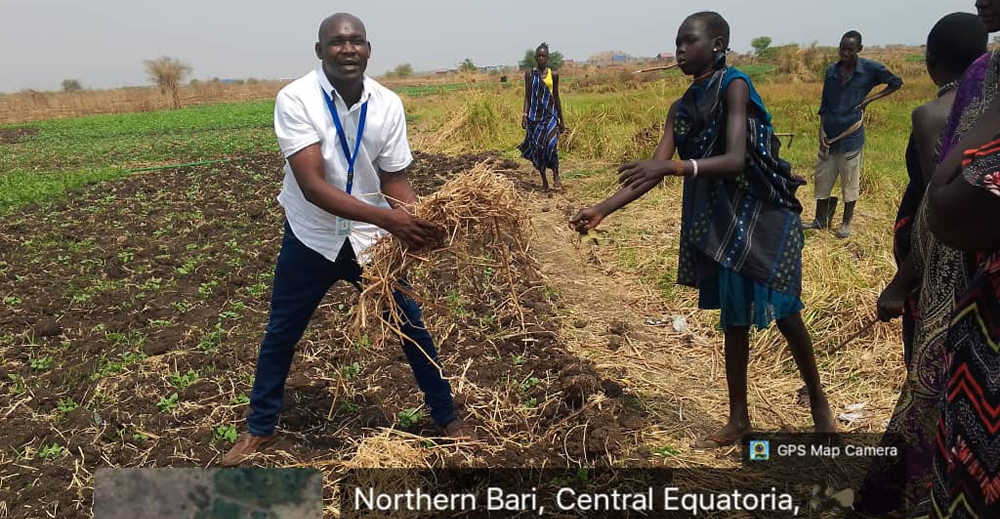
Innocent helps a community in Northern Bari understand water conservation practices by using dry grass as mulch to retain soil moisture and improve crop productivity.
In this blog, Akomi Vic Innocent Legge reflects on how an internship opportunity with the Nile Basin Discourse sparked a powerful transformation in his understanding of climate resilience. Through close engagement with communities in South Sudan, he uncovers the realities they face and the strength of local solutions. He highlights how lived experiences, indigenous knowledge, and collective action are shaping more resilient futures of these vulnerable communities.
My internship with Nile Basin Discourse’s South Sudan National Discourse Forum, has been one of the most defining learning experiences for me. Working with the South Sudan Nile Discourse Forum exposed me not only to environmental and water governance issues, but also to real life challenges faced by indigenous and conflict affected communities.
Understanding climate resilience beyond theory
At the beginning of the internship, my understanding of climate resilience was largely theoretical. However, this quickly changed through direct engagement with communities.
I came to appreciate that, for many communities, water is the invisible backbone of daily life, an indispensable requirement to livelihoods, food systems, and survival. It supports agriculture, sustains livestock, and maintains wetland ecosystems that hundreds of communities depend on. Seeing this connection firsthand helped me understand how deeply environmental systems are tied to daily life.
At the same time, I witnessed how these systems are under increasing pressure. Communities are dealing with extreme weather events, recurring droughts, severe flooding, and growing food insecurity. Limited access to essential resources makes it even harder for them to adapt.
Through field observations, community demonstrations, key informant interviews (KIIs), and focus group discussions (FGDs), I was able to understand these challenges at the grassroots level. These experiences helped me move beyond theory and see the realities of climate change as they affect people directly.
Learning from indigenous knowledge and local practices
One of the most impactful lessons for me was recognizing the value of indigenous knowledge in building resilience. I observed how communities are applying climate-smart soil and land management practices such as cover cropping and crop rotation. These are not new interventions, but long-standing practices that are now proving critical in adapting to changing climatic conditions. I also learned about local strategies for coping with rising temperatures and managing water resources. What stood out to me was that, even with limited external support, communities are actively finding ways to adjust and sustain their livelihoods.
This experience changed how I think about solutions. I now see that resilience already exists within communities, and that strengthening it requires understanding and supporting these local approaches.
Engaging stakeholders across levels
Another key part of my internship was engaging with a wide range of stakeholders at community, national, and international levels. I interacted with community leaders, government representatives, and civil society organizations, and through these engagements, I saw the importance of inclusive decision making in environmental governance. One important lesson for me was that policies and interventions are more effective when they involve the people who are directly affected. Including marginalized groups, especially women and youth is not just important, but necessary for meaningful and sustainable outcomes. Their roles in environmental management are significant, and their perspectives add value to decision making processes.
A learning experience beyond borders
A particularly memorable part of my internship was the peer-to-peer exchange visit to Rwanda, where I had the opportunity to engage with the Rungano-Ndota Youth Initiative. What inspired me most about this youth-led group was how they have organized themselves to promote sustainable livelihoods using their own skills and resources, with minimal external support. Their work showed me that young people can be powerful agents of change within their communities.
This experience left a lasting impression on me. It demonstrated what can be achieved through determination, collaboration, and a shared vision.
What this experience means to me going forward
Looking back, this internship has been more than just a professional engagement. It has been a personal journey of learning and growth. I have gained a deeper understanding of the challenges communities face due to climate change, including floods, droughts, and resource limitations. At the same time, I have come to appreciate the importance of indigenous knowledge and community based coping strategies.
I have also developed a stronger awareness of the roles played by women, youth, and other vulnerable groups in environmental management, and the importance of working collaboratively with different stakeholders. These experiences have shaped how I think about climate resilience and my role in supporting it. As I move forward, I am committed to contributing to efforts that promote a sustainable and secure environment for the future.
Share :
