From Salted Earth to Sustainable Harvests: How Egyptian Farmers Are Reclaiming Salinized Lands in the Nile Delta
Published: 19 October 2025
.....
In Kafr El Sheikh Governorate, farmers are proving that salinity doesn’t have to mean surrender. Communities are restoring degraded lands and renewing livelihoods. Through bio-saline agriculture, innovation, and strong community participation, once-barren soils are turning productive again. This story highlights how knowledge, collaboration, and resilience are transforming the challenge of salinity into a model of sustainable farming in Egypt’s Nile Delta.
Egypt’s North Coast and Nile Delta are among the most climate-vulnerable regions in the world. Home to nearly 17 million people, this fertile yet fragile landscape faces growing threats from rising sea levels, salinization, and coastal erosion; forces that endanger agriculture, housing, and freshwater resources.
In the northern governorates, particularly Kafr El Sheikh, soil salinity has become one of the most pressing challenges to agricultural productivity and rural livelihoods. Once-productive lands are increasingly turning saline, reducing yields and forcing smallholder farmers especially women and youth to adapt or abandon their fields.
A Grassroots Effort to Restore Productivity
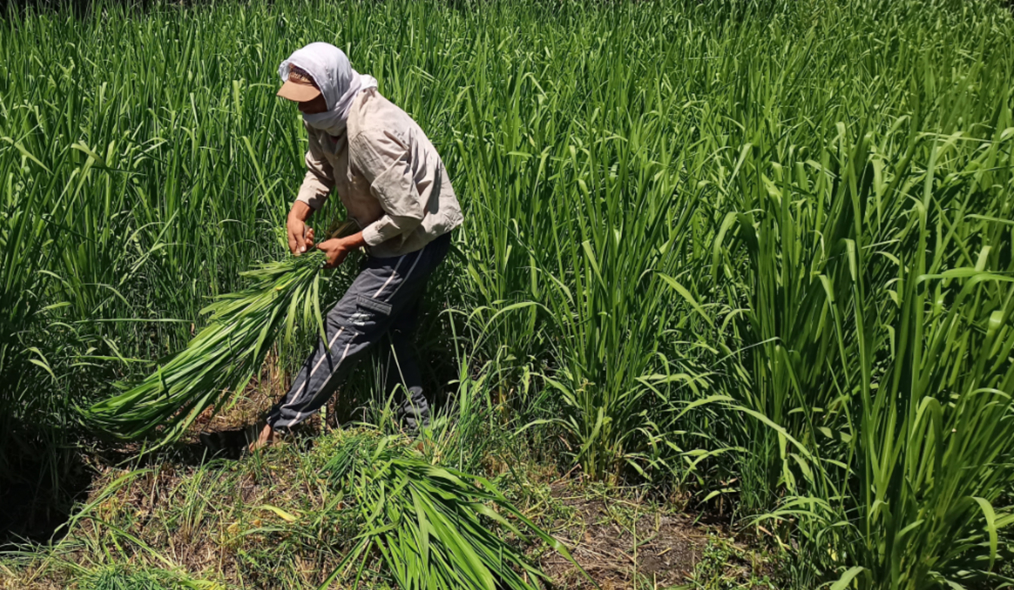
To confront this challenge, the Al Nahda Association for Agricultural Development and Water Management, an active member of the Egypt National Discourse Forum (Eg-NDF) with support from the Ministry of Agriculture, launched a project across several villages in Sidi Salem district. Their goal: to combat land degradation and restore productivity through bio-saline agriculture and sustainable land-use practices.
Spanning four villages: Al-Qun, Abdel-Dayem, Zubaydah Al-Bahriya, and Abu Eleiwa Al-Sharqiya; the initiative engaged 366 farmers directly and reached nearly 900 beneficiaries, including 140 rural women and 45 agricultural extension workers.
From Degraded Soils to Productive Farms
The project took an integrated approach to transform saline soils into thriving agricultural systems. Key interventions included:
- Adopting integrated bio-saline agriculture systems to stop further land deterioration.
- Introducing salt-tolerant and non-traditional crops that maintain yields with less water.
- Improving livestock feed through production of silage and green fodder, and turning agricultural residues into animal feed and organic fertilizer.
- Enhancing local food processing and grain diversification to reduce dependency on external markets.
- Empowering women economically and socially by supporting small agribusiness ventures and engaging them in crop diversification and awareness campaigns.
- Treating and reusing agricultural wastewater to minimize harmful irrigation impacts.
- Developing innovative models for covered drainage networks to address root causes of salinity.
Tangible Impacts on Communities
Through these efforts, farmers in Sidi Salem began to reclaim degraded lands, increase household incomes, and improve food and water security. Livestock owners benefited from more sustainable feed options, while women-led groups gained new opportunities in dairy production and small-scale agribusinesses.
Farmers reported a significant shift in perspective: where soil salinity was once seen as an irreversible barrier to farming, it is now viewed as a challenge that can be managed through knowledge sharing, innovation, and sustained support. This change in mindset has been key to the success and sustainability of the bio-saline agriculture practices introduced by the project.
What Made It Work
Several lessons emerged from the project:
- Integrated bio-saline agriculture can effectively reverse land degradation in salt-affected zones.
- Community participation and local innovation were central to success.
- Women’s empowerment through agricultural diversification built social and economic resilience.
- Collaboration between NGOs, government, and local associations ensured sustainability and ownership.
The project demonstrates that even in the face of advancing climate threats, innovation, community engagement, and knowledge sharing can turn degraded lands into engines of rural recovery.
Project Snapshot
- Communities: Al-Qun; Abdel-Dayem; Zubaydah Al-Bahriya; Abu Eleiwa Al-Sharqiya
- Direct beneficiaries: 366 farmers (61 directly benefiting families)
- Indirect beneficiaries: 690 small farmers
- Women: 140 rural women
- Extension workers: 45
- Partners: Egyptian Desalination Research Center of Excellence – Desert Research Center; Ministry of Agriculture; local agricultural associations
Share :

Related Stories
Key Resources
Author bio