"Many dimensions of data is missing to effectively support inclusive policy formulation. It is the duty of Civil society to map that data. That is the way NBD gives back to the countries; We are not part of conflicts, but part of a win-win solution" Prof. Muawia Hamid SHADDAD
Data is an integral part of every sector in the global economy - Civil Society inclusive. One of NBD's core objectives of Influencing inclusive policy development for equitable utilization and sustainable management of Nile Basin resources highly relies on knowledge and information from communities, and specifically the indigenous grassroots people. Collecting, synthesising, and presenting of reliable, and inclusive citizen science data like any other data requires skilled personnel.
Good afternoon. Allow me to present a statement from NBD; a twin sister of the NBI. We have more than 620 member organizations in the ten countries of the Nile Basin and we have been there from the very beginning. We were there when NBI went to the first donor conference in which NBI got promises of 500 million dollars. So please allow me to deliver the statement.
Distinguished ministers,
Executive director,
Ambassadors,
TACS and Participants at NBDF 2021,
On behalf of Nile Basin Discourse and on my own behalf, allow me to express my deep pleasure of being part of the closing days of Nile Basin Development forum of 2021. I say Thank you to NBI and to the Democratic Republic of Ethiopia for hosting the historical NBDF 2021.
Discussions at this NBDF which has its theme: Rethinking Regional Investments in The Nile Basin”, have been informative and have brought up pertinent issues for cooperative development. This theme is supported by 6 sub-themes of:
Water security
Energy security
Food security
Environmental sustainability
Climate change adaptation
And trans-boundary water governance
The sub-themes are important to the stakeholders of the Nile, therefore important to NBD. A number of messages have come out of the virtual webinars that ran for a number of weeks in addition to physical meetings of yesterday and today.
NBD sees many aspects of working together in all key messages that have been virtually produced. However, I would like to highlight a few of these messages that hopefully will be on the priority list for a follow up action of our two organizations of NBD and NBI.
The first priority that I would like to appoint is:
Destruction of environment and effect to the Nile Riparian communities across the basin. The general destruction of the environment and ecosystem, watershed and pollution of services and ground water is occurring at an increasing rate. This is threatening the sustainability of ecosystems; and many goods and services derived from the natural resources base that the Nile Riparian communities are depending upon for their sustenance and economic development.
Water resources Data and information: NBD is complementing NBI with Citizen Data. The demand for timely and accurate water resources data and information to support strategic and operation in decision making and support the identification and design of national and regional water infrastructure is on the increase. The increase in demand is driven by multiple factors including socioeconomic development, and the impact of global climate change which are manifesting strongly in the region
On February 22nd February 2021, the Nile Basin Discourse (NBD) joined Nile Basin Initiative (NBI) to celebrate the Regional Nile day that was hosted by the Republic of Uganda. The event held virtually attracted different stakeholders, government officials, and Development Partners among others. The theme for this year's celebration was “Rethinking Regional Investments in the Nile Basin”.
At the virtual occasion, NBD made a statement delivered by NBD Board Secretary General Mr. Donald KASONGI on behalf of NBD Board Chair person, Prof. Muawia Hamid SHADDAD. (Read full statement also attached at the bottom)
In his message, he reiterated NBD commitment to continue cooperation with NBI to ensure that the current strategic partnership yields benefit to Nile Basin citizens.
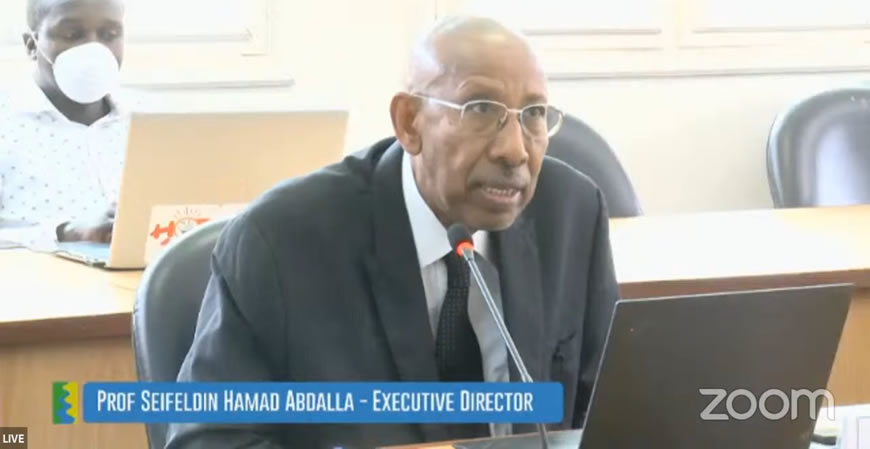
Prof. SEIFELDIN Hamad Abdalla, the NBI Executive Director
At the same event, a 5-year Memorandum of Understanding (MoU) was signed between NBI and NBD. The MoU intends to strategically stimulate and facilitate partnership on activities and projects between the two institutions. The just signed MoU is effective from 2021 until 2025. It builds on the previous successful MoUs that were signed between the two parties in the previous years.
On the 22nd February 2020, ten Nile Basin Countries met in Khartoum - Sudan to Commemorate the Regional Nile Day. The 14th Nile Day celebrations organized by Nile Basin Initiative (NBI) and hosted by the Republic of Sudan brought together various stakeholders, Development Partners, delegates from NBI member countries and the general public.
The theme for this year's celebration was: “Joint investments on the Nile for Regional Transformation”.
Nile Basin Discourse (NBD) as a key Stakeholder of the NBI participated at this event; the Sudan Nile Discourse Forum, the NBD Board, and the NBD Secretariat staff represented the NBD family on this occasion.
Summary of Remarks Made By the NBD Board Chairperson at Nile Day 2020, Khartoum – Sudan
At the event, the NBD Board chairperson Prof. Muawia Hamid Shaddad, delivered a statement on behalf of the NBD family. In his address, he reiterated NBD’s commitment to cooperating with NBI through the promotion of dialogue, awareness and consultation among others. He outlined NBD’s achievements towards trans-boundary cooperation through capacity building, outreach, awareness promotion, consultation, and communication at National and transnational programs, in focus of joint investments. He also informed participants that NBD has focused on integration, inclusion, and collaboration on waters of the Nile ever since its establishment.
Prof Shaddad said that currently, the main objective has been to enhance, and draw responses to critical issues across the riparian countries towards achievement of transformative agenda 2030 in development and cooperation.
While concluding the remarks Prof. Shaddad reiterated NBD’s commitment to working closely with NBI centers and governments of Nile Riparian States to foster cooperation, and support initiatives that lead to joint investments of Nile Subsidiary action programs. Click here to get the full statement.
About NBD
Nile Basin Discourse (NBD) is a network of Civil Society organization established in 2003 with the support of World Bank and other Development partners to strengthen civil society participation in Nile Basin (NBI) development processes, projects, programs, and policies. The NBD has evolved into an independent network of over 600 member organizations throughout the Nile basin. Member organizations are local and national CSOs/NGOs working on a range of issues relevant to Nile cooperation; including environmental conservation, agriculture, energy, gender equity, livelihoods, poverty reduction, and others. The CSOs/NGOs are members of chapters at national level referred to as Nile Discourse Forums (NDFs) established in each of the eleven riparian states. The NDFs in turn form the NBD Network, coordinated by a regional Secretariat based in Entebbe, Uganda. For more information visit our website at www.nilebasindiscourse.org
Women in Mabamba Bay on the shores of Lake Victoria in Uganda expressed their commitment to improving Water, Sanitation and Hygiene (WASH) in their community. They also showed high inspiration and commitment to promote environment-friendly development practices in their area. The commitment came after the Learning Caravan facilitated by NBD and other partners from November 2019 to January 2020. The learning caravan provided several women groups the opportunity to share knowledge and best practices from neighboring households on issues related to WASH and environmental management.
In 2018 NBD and IHE Delft signed the partnership framework agreement for the project entitled “Women and Water for Change in Communities” a 2-year project funded by the Coca Cola foundation. Read details of the project from the UN-IHE website HERE. Overall, the project was implemented at Mabamba Bay area in Uganda, and Mara river basin in Tanzania. Under this partnership framework, NBD conducted trainings on “Empowerment of Women and youth as Climate Resilience Champions”, targeting selected women and youth that are capable of influencing their communities for both Tanzania and Uganda.
As a follow-up to the 2018 training; from November 2019 to January 2020, NBD in partnership with Network for Water and Sanitation (NETWAS) facilitated communities from three villages of Mabamba Bay (Lubya, Nakasozi and Ziba) to hold a Community Learning, Knowledge development, and best practice Exchange caravan in Uganda.
The major objective of the caravan was to enable the communities to share, learn knowledge, and best practices about good WASH and environmental management from each other so that knowledge and best practices are duplicated within the households, villages, and beyond.
Through house to house visit, participants of the learning caravan were able to see Hygiene and Sanitation facilities in the neighborhoods and, learned about best WASH practices as explained by the owners of the facilities and the expert facilitators who facilitated the caravan.
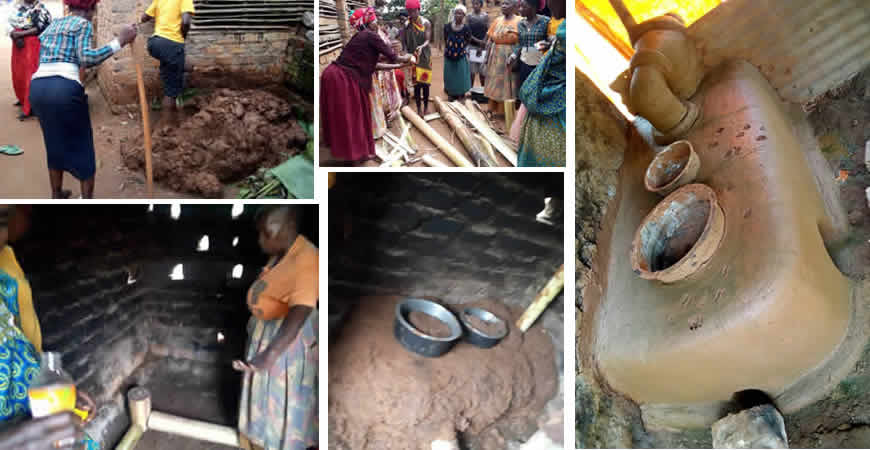
Women leaders from Mabamba also toured Katosi Model Village in Mukono as an exchange visit, from where they learned on how to make improved energy cooking stoves. Women learning and actively participating in the building/making of modern and energy efficient cooking stoves - All stages From start to finish
Learning by doing: Results talk from the ground
Around 100 women and men from Mabamba Bay area participated in the caravan. Ms. Irene Namubiru who chairs the Mabamba Women Group says that they learnt a lot about WASH under NETWAS coaching including the making of energy efficient cooking stoves.
After the learning caravan, women from three villages managed to construct 8 latrines, 35 utensils drying racks, 75 tip-taps for hand washing, 26 energy cooking stoves, and dug 52 rubbish pits.
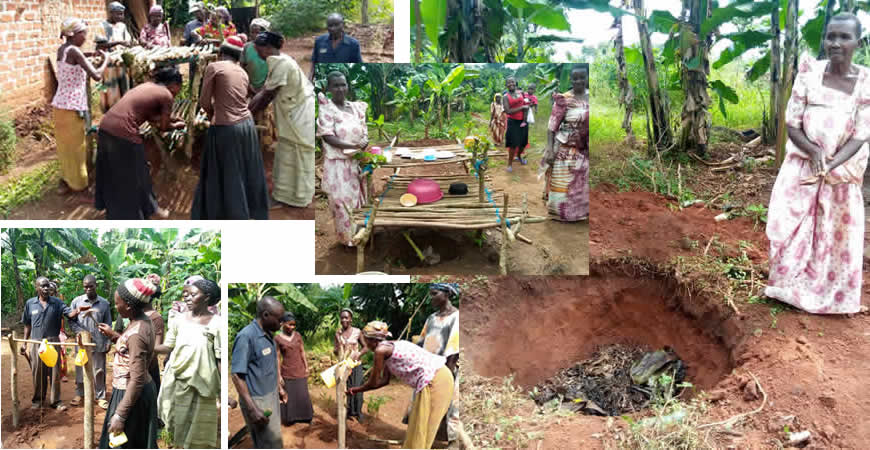
Participants of the WASH learning caravan during a hands on exercise on digging rubbish pits, making utensil drying racks, and making of tip-taps to facilitate washing of hands after use of Latrines
As a model and strategy of continuity of the program, women groups have also started recruiting men, youth, and children to be part, learn and carry on the knowledge in their communities.
The learning caravan exercise was crowned with a one day results/experience sharing meeting of groups from different villages.
Local council leaders and representatives of the local government graced this occasion and expressed their gratitude for such exciting but also educative arrangement that will benefit these communities not only today but through the years to come.
At the same gathering, children of Mabamba bay community presented a poem on WASH and conservation of the environment as in the video on the right >>
The women community highlighted a few challenges:
1) They expressed the challenge of lack of access to safe water despite their closeness to a large water body. The search for safe water at distant places puts the girl child at great risk since they are the most involved in fetching water in their communities. They community welcomes any opportunity geared towards solving the water crisis in this area.
2) The current women groups are self support initiatives to boost family self support. The groups have started venturing into Savings And Credit Co-Operative (SACCO) initiatives but are short of funds to have these SACCOs grow and evenly support their membership.
3) They need capacity building on Credit and Savings in order to better manage these the credit schemes/SACCOs
4) The women also requested to be facilitated to have more exchange visits even in other countries where NBD operates so as to share experiences, but also carry on the knowledge exchange and self learning program.
On the 22nd of February 2018, Nile Basin Discourse (NBD) joined Nile Basin Initiative (NBI) and the 10 Nile riparian states to celebrate the 12th Regional Nile Day in Addis Ababa - Federal Republic of Ethiopia. The theme for this year's celebration was: "The Nile: Shared River, Collective Action".
NBD was represented by members of the NBD Executive Board, NBD board member for Ethiopia, member Civil society organizations of the Ethiopian National Discourse Forum, and the NBD Secretariat Staff.
In a statement delivered by the NBD Secretary General Mr Donald KASONGI on behalf of the NBD Board Chair Prof. Muawia SHADDAD among other issues reiterated that the NBD Network is ready and will continue to work closely with NBI Centres and Governments of the Nile Basin to foster cooperation and support initiatives that lead to enhanced optimal and collective sharing of the resources of the Nile.
We invite you to read the full statement attached herewith.
For more information about NBD and our activities, please contact us at This email address is being protected from spambots. You need JavaScript enabled to view it. or visit our website at www.nilebasindiscourse.org. You can also follow us on Facebook, Twitter, and Youtube.
Representatives of Civil Society Organizations in the Nile Basin, experts in water resources, researchers, development partners and media gathered in Entebbe, Uganda for 1st Nile Basin Discourse Summit held from 29th to 30th November 2017. Hundreds of participants from across the basin and beyond discussed the challenges, opportunities, experiences and best practices of cooperation and development investment in River Basins, especially the Nile.
On September 25th, 2015, countries adopted a set of goals to end poverty, protect the planet, and ensure prosperity for all as part of a new sustainable development agenda. Each goal has specific targets to be achieved over the next 15 years.
From 16th - 20th January 2017, the Nile Basin Discourse (NBD) held virtual discussions on the implementation of Sustainable Development Goal (SDG) 13, which requires signatories to take urgent action to combat climate change and its impacts. The virtual discussion was focused on getting on-the-ground views towards Indicator1, (i.e. “Number of countries that have integrated mitigation, adaptation, impact reduction and early warning into primary, secondary and tertiary curricula”), of Target 3 (i.e. Improve education, awareness-raising and human and institutional capacity on climate change mitigation, adaptation, impact reduction and early warning). The aim of the discussion was to examine the extent to which indicator 1 of target 3 of the SDG 13, was being implemented at national levels and the role the civil society organizations (CSOs) are playing to influence implementation of the target through advocacy in the ten Nile Basin countries namely Burundi, D.R Congo, Egypt, Ethiopia, Kenya, Rwanda, South Sudan, Sudan, Tanzania and Uganda.
The virtual discussion participants included the NBD Network of experts on climate within the Nile Basin countries, the NBD Board members, the National Discourse Forums’ (NDFs)-Technical Support Experts, selected members and partners of the Nile Basin Discourse.
Participants also discussed the role of CSOs in awareness-raising towards enhancement of the Governments efforts in fast-tracking Target 3 of Goal 13. The discussions cantered especially on the CSOs’ influence of the speed of implementation of the SDG at the learning institutions and the advocacy for the beyond institution outreach to grassroots communities. According to the participants, there was low level of involvement by civil society organizations in the implementation of the awareness-raising element of target3 of goal13. It was therefore agreed, that CSOs fill the gap of educating the community on climate change impact, mitigation and early warning signs by forging a strong partnership with Governments of the Nile Basin Countries, as a plausible way to ensure the efficient and effective implementation of SDG13 – Target 3.
The integration of climate change mitigation, adaptation, impact reduction and early warning into primary, secondary and tertiary curricula and their implementation was viewed as fundamental to guarantee success of the target. In addition, the capacity and skills of University lecturers, School teachers, and other community educators is equally vital to the development of human capital required for the successful achievement of target3 and indicator1 under discussion.
In Summary, the emerging issues from the discussions were: (i) that for some of the Nile Basin countries, the target was being intergraded in the national plans, however the implementation process needed fast-tracking, (ii) that despite the fact that the target was being considered and integrated into National plans, there was lack of a metric system to measure the success of the target, and (iii) that there was need for national and trans-boundary outreach programs beyond the learning institutions to grassroots communities that could be enhanced by advocacy and capacity building activities to enhance the awareness –raising.
The Nile Civil Society is advocating for an enabling environment in trans-boundary community development outreach, especially in the trans-boundary multipurpose Investments of the Baro-Akobo-Sobat and the Nyimur-Aswa community livelihood enhancement developments. At the 11th Nile Day of February 2017, the Nile civil society considered the commemoration as the opportunity to all stakeholders, governments and communities to reflect on the role of the river Nile, that is to be share sustainably by all in the energy, food and the water it provides. Knowing that trans-boundary community development, are to the people, for the people and by the people.
The Nile Basin Discourse Board Chairperson Dr. Nadir Mohamed Awad in his speech and advocacy encouraged the Nile Governments and Development Partners to direct their efforts on two emerging issues on trans-boundary investment developments of the Nile Riparian States, thus:
(i) that Governments make effort in providing the enabling environment for development benefits to reach communities; and (ii) that development partners implement agendas with minimal costs to the communities.
The Nile Basin Discourse had the opportunity to contribute to the statement and policies of the Budapest Water Summit 2016(BWS2016) that took place on the 28th to 30th November in Budapest, Hungary. Through invitation and support by the Hungarian Ministry of Foreign Affairs and Trade, and the Women for Water Partnership (WFWP) Netherlands, NBD’s Regional Manager, Ms Hellen Natu was one of the panellists of the 'Water connects - Cooperative Solutions and Best Practices without Borders” Session of the Women Forum - BWS2016, held in Budapest, Hungary. At the panel, NBD advocated for financing of grassroots communities especially women and linking them to the private sector. Ms Natu's contributions emanated from results of NBD's project titled Engaging Civil Society for Social and Climate Resilience in the Nile Basin (2013-2016) funded by Cooperation in International Waters in Africa (CIWA)/World Bank.
The session was coordinated by Ms Eszter Szabo, the advisor to the President of Hungarian Business Leaders Forum (HBLF), a Hungarian non-profit that was founded by the Prince of Wales to promote fair business practices just after the fall of the Iron Curtain. The key player in Budapest was Ambassador Viktoria Horvath, who really put her heart behind the female gender.
The Nile Basin Discourse is promoting the young and creative mind, Student – Innovative – Idea exchange initiative with higher learning institutions of the Nile Basin and those outside the Nile Basin. The basic drive is for NBD to gain and tap-in from partnering institutions’ cost-shared contribution of young innovative ideas, experiences and cost-effective human capital. The partner institutions benefit from young minds’ sharing of experiences and lessons learned, outside the incubator. The partnership has the possibility of contributing to increase in innovations to benefit communities in the Nile Basin and beyond. Based on the mutual benefits the NBD therefore, has set-up an innovative ideas corner desk at the Secretariat in Entebbe - Uganda.
As a follow-up, and starting this 4th quarter of 2016, the NBD and the Geographic Department of the Humboldt-University in Berlin, Germany, have put in place the possibility of implementing the student-innovative-idea exchange and the sharing of experiences. The first student has already reported and is occupying the desk at the NBD Secretariat. On the desk is Thomas Betzold who has been trained in hydrology and resource management. He is to occupy the corner from October till December 2016. In the three months of the initiative, and in addition to the desk occupied, NBD provides mentorship in community engagement, the case of civil society organizations in the Nile Basin Riparian States.
His innovative ideas are to emerge from the university, and the fact that he has participated in study projects concerning the management of the Spree Catchment, a river in eastern Germany and the quantitative estimation of small rivers in Thuringia, Germany. In general, Thomas has interest in international rivers. In addition, his area of inclination is the participatory, inclusivity, and the horizontal and vertical evidence-based advocacy approach to resource distribution, as fronted by the Nile Basin Discourse.
Today October 3rd 2016 in Entebbe - Uganda, the Nile Basin Discourse’s Regional Manager(RM) Dr. Hellen Natu, held a meeting with the new Nile Basin Initiatives’ Executive Director(ED) Eng. Innocent Ntabana, at his office at the NBI Secretariat. The NBD – RM was accompanied by NBD’s Associate Mr. Thomas Betzold of Humboldt University Berlin, Germany. The objective of the meeting was to welcome Eng. Ntabana and reaffirm the collective responsibilities and common goal of both the NBD and the NBI, to work towards improving the livelihoods of the people of the River Nile Basin.
ln recognition of the benefits to be gained through a cooperative agenda that promotes sustainable development interventions in the Nile Basin region, the heads of NBD and the NBI discussed their partnership towards the mutual goal, that intend to stimulate and facilitate the scope of the activities of both institutions, which though with separate mandates are complementary. Emphasized were the two pipelines, vertical and horizontal; communication towards collaborative NBD-NBI advocacy that reaches grassroots and decision makers.
At the meeting, a brief update on the mutual complementarity of the two organizations formed the discussions. At the same time, a welcome letter to the ED from the NBD’s Board Chair Mr. Jean Baptiste Habiyaremye was hand delivered, in addition to the NBD Stakeholder Mapping Report, Nile Basin Countries (2015). This is a key report to inform the ED on NBD’s activities, membership, thematic and geographic set-up of CSOs per cluster of the Nile Basin Riparian States.
The two parties positively agreed on the need to utilize the strength of their respective organizations to develop water resources of the basin in a sustainable and equitable way, ensure prosperity, security, peace, efficient management and optimal use of the resources to reduce poverty and promote economic integration in the Nile basin.
The Nile Basin Discourse (NBD), a key stakeholder in the Nyimur Project, contributed to preliminary discussions with the consulting team on the socio-economic baseline of the Nyimur multipurpose water resources project studies for implementation. This was during a working visit which took place on August 22nd 2016 at the NBD Secretariat. The Issues of discussion centred on understanding NBD’s stake in the project and getting its insights and suggestions on what it considers as pertinent gender and socio-economic issues that should inform the feasibility study.
The Nyimur multipurpose water resources project is a brain child of the Nile Basin Initiative’s Nile Equatorial Lakes Subsidiary Action Program (NELSAP). It is to be implemented as trans-boundary at both the Republic of South Sudan and the Republic of Uganda sides. On implementation, it is to reduce poverty and increase economic growth of the people by improving availability of water resources for livelihood as well as productive activities, such as agriculture. Ultimately, the project is aimed at improving, the two countries’ socio-economic development through water resources management and development, to increase water availability through flood mitigation, irrigation agriculture, electricity generation, fisheries and water supply and sanitation in both Uganda and South Sudan.
The Nile Basin Discourse plays vital roles in this project because of its mandate to communicate information of the NELSAP – Nyimur project to communities, consult on the emerging issues prior to and during implementation of the project, and facilitate discourse platforms on cooperation.
Therefore for the baseline, the stake of the Nile Basin Discourse in the Nyimur multipurpose water resources project is the trans-boundary discourse on vulnerability reduction, especially through trade of agricultural products and cooperation of the two countries on the shared water resources. The stake is a follow-up of NBD’s activities initiated in September 2015 in Lamwo district, Uganda and also in March 2016 in Magwi County, South Sudan with support from the Cooperation on International Waters of Africa (CIWA)/World Bank, Phase1. NBD in collaboration with the NELSAP, the governments and the National Discourse Forums (NDFs) of South Sudan and Uganda, successfully participated in national task force meetings and held grassroots consultations with citizens of the two countries, to hear their voices on the Nyimur project and also to create a sense of ownership of the project. The citizen’s earnest voices, especially from the women, were mainly on the transboundary access to markets, and on peace and cooperation of the two Nile Basin countries.
The Nile Basin Discourse (NBD) participated in the launch of the Fodder and Range Platform organized by IGAD’s Center for Pastoral Areas and Livestock for Development (ICPALD), in collaboration with partners including the NBD, on July 11 – 12 2016 in Entebbe, Uganda.
NBD’s presentation highlighted elements of efficient use of both green and blue water, citing past studies on the water footprint of beef animals in rangelands and on fodder feeds respectively. Again, NBD put its finger on the importance of discourse on trans-boundary water resource sharing and use that minimizes vulnerability, especially along the corridors of livestock “on hooves” in the three selected countries, namely Ethiopia, Kenya and Uganda.
The launched Range and Fodder Platform, is to facilitate production and conservation of fodder that is to be accessed by all small holder livestock keepers at affordable costs to mitigate vulnerabilities of pastoralists in the three countries and beyond.
According to IGAD-ICPALD, the world's Arid and Semi-Arid Lands (ASALs) are dominated by pastoralism that is an extensive mobile rearing of livestock on communal rangelands that are dominant in the IGAD region. It is a major livelihood and production system practiced in ASALs and employs a high percentage of the population, with estimates indicating that there are about 120 million pastoralists/agro-pastoralists worldwide, of which 50 million are found in Sub-Saharan Africa.
NBD’s effort was to bring to the fore for discourse, through its CSOs network in the three countries, the elements of trans-boundary water resources efficient use and governance towards enhancing the livelihood of vulnerable communities in the ASAL region of the three selected IGAD member states that overlap into the Nile basin.
August 1st 2016, saw a visit to the Grand Ethiopian Renaissance Dam (GERD) that was organized by the Stockholm International Water Institute (SIWI). Representatives of the visit included the team from the Media Houses of the Eastern Nile Countries of Egypt, Ethiopia, South Sudan and Sudan; the Nile Basin Initiative’s - Eastern Nile Technical Regional Office (ENTRO), the NBI Secretariat; and the Nile Basin Discourse (NBD). NBD was represented by the NBD’s General Assembly representative from Egypt Ms Souzan Mohamed Zaki and the Regional Manager Ms. Hellen Natu. The visit was to observe and question the realities on the ground and develop a constructive media approach on the Eastern Nile. Prior to the meeting, the group benefited from a number of presentations by experts.
According to Eng. Semegnew Bekele, the GERD - Project Manager, the GERD is to be the 8th biggest in the world. It has a 1,870 m long and 145 m high concrete dam, with spillways and a saddle dam. The reservoir area will cover 1,874 square kilometres at full supply level of 640 meters above sea level. It is being constructed for the purpose of generating electricity with total installed capacity of 6,000 MW. In addition, it is supposed to increase job opportunities, with outreach programs that reduce poverty and vulnerability taking in consideration gender issues.
With the GERD in focus, the NBD is keen on carrying the message vertically and horizontally through the pivotal points of messaging engagements towards (i) nurturing Nile cooperation and (ii) contributing towards participatory approach to development, fostering accountability and speed in response to emerging issues of development by governments and local people. In a presentation made by the NBD Regional Manager, she stressed on the role of media and informed participants that in the NBD Strategy 2012 – 2017, media appears in strategic direction that establishes the Nile Media Platform. Also NBD’s network structure has involved media organizations that are active members of the network. At this point in time, the NBD took the opportunity to announce the on-coming bi-annual platform of discourse and experience-sharing on emerging issues of cooperation and development on the Nile and beyond; the “Nile Basin Discourse Summit”. For more information on the GERD visit please download some of presentations here:
The NBI spearheaded the preparation of the annual event in collaboration with the NBD and the government of the host country-Kenya. The Kenya National Discourse Forum (KNDF) was part of the National Organizing Committee (NOC) in Kenya, while the NBD Secretariat worked as amember of the Regional Organizing Committee (ROC) spearheaded by the Nile-Sec in Entebbe, Uganda.
At the expo, NBD had an opportunity to interact with other exhibitors such asthe three centers of NBI (Nile-Sec, ENTRO, and NELSAP), National Environmental Management Authority of Kenya, Water Services Trust Fund-Kenya, Kenya Water Towers Agency, Lake Victoria South Water Services Board, Ministry of Water and Irrigation-Kenya, and Water Appeal Board-Kenya. NBD’s exhibition table was visited by fairly a number of people includingMinisters.
The Regional Nile Day 2016 Celebrations was attended by Ministers in charge of Water Affairs in the Nile Basin countries, Permanent Secretaries, members of diplomatic community, Development Partners, Researchers, Academia, Civil society organizations, Youth, International and National media houses, school children, and communities of the Vihiga County.
The Celebration was officiated by Professor Judi WangalwaWakhungu, Cabinet Secretary for Environment, Water and Natural Resources-Kenya. In her speech, she stressed thatsustainable and efficient management of the Nile resources is a matter of life/survival as millions of newly born people join the Nile community every year in the face of climate change and land degradation. “Addressing challenges of Nile cooperation requires joint action and confidence/trust building,” said the Cabinet Secretary of Kenya. She reminded participants about the Theme of the Nile Day:“The Nile cooperation: Gateway to regional integration,” andsaid that regional integration is possible through activities “which focus on our common culture and unity within our diversity.” She remarked that “NBI is one of the great pillars among our common institutions for regional cooperation and integration that guides and advises riparian countries on how to share the Nile River resources.” She finally appealed to the Nile community to enhance socio-economic benefits to the Nile citizens through increased and sustainable cooperation.
At the Celebration, NBD was given a slot where the NBD Board chairperson, Jean Baptiste Habiyaremyedelivered a speech. In his deliberations, the chairunderlined NBD’s mandate to foster cooperation within the Nile riparian states through increased people to people relationships/interactions under its motto of “One-Nile One-Family.”The chair disclosed that NBD is working hard to contribute to overcoming challenges surfacing the Nile Basin region such as impacts of climate change, inclusivity of stakeholders in the Nile development and cooperation agenda, and mainstreaming gender in the sustainable development of water.Mr Jean Baptiste, added that“currently NBD is making contributions to NBI’s Subsidiary Action programs (SAP) development agenda of projects supported by two centers namely ENTRO and NELSAP, in the sub-basins of Aswa-Nyimur of South Sudan and Uganda; the Baro-Akobo-Sobat of Ethiopia and South Sudan; and the Lakes Edward - Albert Fisheries (LEAF) of D.R. Congo and Uganda.”
He concluded his speech by reiterating NBD’s readiness to work closely with NBI to foster cooperation and supporting any initiative that leads to the regional integration.He said “Nile is our history, Nile is our resource. On the Nile, we are the family let us join our hands for it and sustain it.”
NBD completes Nile Basin stakeholder mapping with key emerging issues for each of the 10 riparian states namely Burundi, D. R. Congo, Egypt, Ethiopia, Kenya, Rwanda, South Sudan, Sudan, Tanzania, Uganda. Issues of stakeholder/community consultation, bottom-up communication and physical intervention, and stakeholder capacity building emerged with emphasis.
The Nile Basin Discourse (NBD) joined other partners, namely the Nile Basin Initiative (NBI), Global Water Partnership Eastern Africa (GWP-East Africa), Deutsche Gesellschaft für Internationale Zusammenarbeit (GIZ) and Deustche Welle in awarding outstanding journalists on Nile issues. The event took place on 4th June 2015 in Dodoma - Tanzania.
On the 4th of June, 2015, the Nile Basin Discourse; at the representation of the Regional Manager, Dr. Hellen Natu the NBD Board Chairperson, Mr. Jean Baptiste Habiyaremye and the NBD Board Member - Kenya, Mr. Joseph Peter Ngome attended the 23rd annual Nile Council of Ministers (Nile-COM) meeting in Dodoma - Tanzania. The Nile-COM comprises of Ministers in charge of Water Affairs from the Nile Basin Member States and is the highest decision and policy-making organ of the Nile Basin Initiative. The Nile Basin discourse is one of the few partners to NBI that are allowed to attend this closed meeting.
The Nile Basin Discourse (NBD) is conducting Stakeholder Mapping in the 10 Nile Basin Riparian States with the intent to address communities’ interests and concerns pertaining to social and climate resilience investment policies, projects and programs. An effective stakeholder engagement process presupposes a robust stakeholder mapping product to base the discourse platforms on.
Nile Basin Discourse (NBD) received a special invitation to participate and present 3 papers in the 7th World Water Forum, Daegu & Gyeongbuk 2015 - "Water for our future". NBD is represented by the Regional Manager, DR. HELLEN NATU, NBD chairperson, Mr. HABIYAREMBYE JEAN BAPTISTE and NBD Secretary General Mr. LEONARD KASONGI.
NBD values the role of media in information and education within Nile countries. Hence NBD has partnered with Nile Basin Initiative (NBI) in preparations of Nile media awards to be delivered in 2015. With these media awards, NBD is optimistic to see the boost of professional coverage on the matters related to Cooperation on the Nile and engaging communities on climate change resilience/adaptation issues.
To celebrate the 9th Nile Day of February 22nd 2015, the Nile Basin Discourse (NBD) joined the Nile Basin Initiative (NBI) and the rest of Nile riparian states in Khartoum, Sudan. The two organizations spearheaded the preparation of the annual event in collaboration with the government of the host country-Sudan. The Sudan National Discourse Forum (SNDF), an arm of NBD played part in the National Organizing Committee (NOC) while NBD Secretariat closely working with the Nile-Sec in Entebbe, Uganda.
"Bridging the gaps in Public Participation" 15-16 November 2011, Speke Resort, Munyonyo, Hotel, Kampala, Uganda.
NBD would like to commend the NEL countries for embarking on developing a regional power master plan involving a series of interconnections lined up for countries in the Nile river basin region.
ENTEBBE, Uganda – NBD would like to extend its warmest congratulations to the Ethiopian and Egyptian Prime Minister’s on the recent agreement to open a new chapter of relations based on a win – win strategy and set up a technical team to review the impacts of the Grand Ethiopian Renaissance Dam. The outcomes of this meeting have clearly confirmed