Direct beneficiaries of the project total to 4,100 households with approximately 20,500 people living in eight rural kebeles out of which 52% are women; the beneficiaries are generally resource poor, disadvantaged and vulnerable groups. To build resilience of the target communities against impacts of drought and climate change, the project implemented diversified livelihood options. The target communities actively participated in planning, implementation, and monitoring. The project planned interventions were successfully implemented with great achievement.
Ethiopia is predominantly rural with a large population depending on agriculture and pastoral activities, but there has been limited development of surface water and groundwater resources for irrigation. Agriculture which is rain-fed accounts for 46.3% of the nation's Gross domestic Product (GDP), 83.9% of exports, and 80% of the labour force.
Unfortunately, drought has frequently plagued Ethiopia and is a major climatic hazard that impacts the long-term sustainability of this rapidly growing African nation. The recurrent drought puts pressure on agricultural production and overall socio-economic development of the country.
Shebel Berenta is among the three food insecure districts in Amhara Regional State; with an estimated population of 130,800 people (52% females) but overall, 92% being rural dwellers. Agriculture, mainly crop and livestock production is the main economic base of the area. Shebele Berenta is divided into two major zones with 72% of the district falling within semi-arid climatic zone while the 28% is midland (Woinadega). Data from Woreda Agricultural Office show that Shebel Berenta is a highly food insecure district and all Kebeles (wards) are supported by the Productive Safety Net Program (PSNP) which targets the poorest of the poor with cash or food–for-work programs. 55% of the households in this area face seasonal food shortages especially in the months of July to October.
Agri Service Ethiopia (ASE), a member of the Ethiopian Nile Discourse Forum has been working in Shebel Berenta since 2016; building communities’ resilience against drought risks through an Integrated Community Development Project - generously funded by Brot für die Welt (BftW). The project interventions tackle food insecurity, limited access to potable water supply and sanitation, gender imbalance, poor economic status of women, youth unemployment, negative impacts of climate change, natural resources conservation, and capacity building for communities.
The cause of food insecurity is majorly low agricultural production as a result of erratic rainfall conditions, fragmented and small landholding size, rain-dependent monoculture, traditional and backward agricultural production systems, uncontrollable crop pests and diseases, and soil erosion among other factors. Extreme food insecurity has resulted into food gap, high rate of malnutrition, subsistence livelihood, affected children’s education, and has increased migration in search for employment.
Notably, women suffer from socio-cultural discrimination and have fewer opportunities for personal growth, education, and employment compared to men. There is lack equity in the distribution of power and decision-making between men and women at all levels of the governance structure and local institutions; there are less than 15% of women in leadership as compared to men.
The direct beneficiaries of the project total to 4,100 Households with approximately 20,500 people living in eight rural kebeles out of which 52% are women. The direct beneficiaries are generally resource poor, disadvantaged and vulnerable groups.
To build the resilience of the target communities against the impacts of drought and climate change, the project implemented diversified livelihood options. The target communities actively participated in planning, implementation, and monitoring. The project planned interventions were successfully implemented with great achievement.
The Interventions:
Community learning and organization: ASE used Community Learning Forums (CoLF) combined with Saving clubs involving up to 30 people (50% women) per CoLF, who will regularly meet once a week. Under ASE’s guidance, communities themselves prioritize and select social, economic, and environmental key problems of learning and prepare an annual CoLF action plan. Weekly CoLF learning sessions on the topics identified are cascaded by ASE’s development facilitators and peer learning in their villages. In line with learning, they do savings and internal lending that support small businesses for members.
Project Sustainability: ASE has home-grown experience of phase-in and phase-out strategy; projects are started and taken over by established and organized legal Community-Based Institutions (CBIs). Therefore, Finote Belay community-based Association was established during phase I of the project and remains responsible for mobilizing, coordinating, and leading project activities and development initiatives within their locality
Food Security: Food Security and income of the target small holder farmers were improved through crop & livestock diversification and capacity building trainings. Specifically, farmers were supported to access drought resistant & early maturing crop seeds such as vegetables, lowland fruit seedlings, and trainings on proper agronomic practices and techniques such as the revolving system. In addition, resource poor women and landless youths were trained and supported with shoats & poultry as income generation.
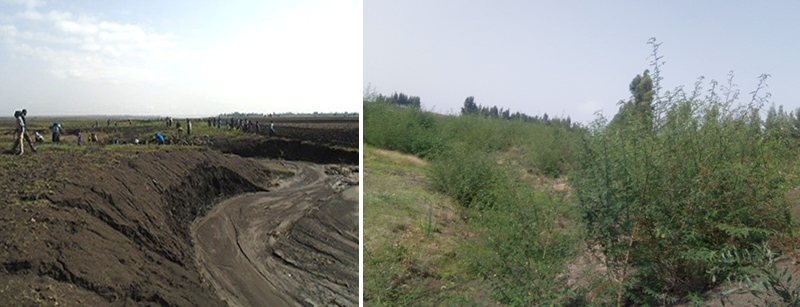
Yedhua gully before intervention in 2017 and after Conservation and tree planting in 2018Natural Resources Management: Degraded lands were rehabilitated through establishing of individual & community tree nurseries, production & plantation of multipurpose tree seedlings, area closure, gully treatment, promotion of agroforestry on the farm lands, organizing capacity building/exposure visits and skill trainings.
Introduction of alternative energy sources: Biogas and fuel-efficient stoves were introduced and promoted in the project area. Selected households benefited from these technologies which also reduced the need for firewood. Biogas provides rural households with lighting, and the bio celery is used as composite for vegetable production.
Access to water for multipurpose use: The project developed small scale irrigation schemes using the rivers in the target kebeles and promoted house hold irrigation technologies like the rope & washer pumps by digging wells. These enable farmers to grow vegetables and other food crops three times per year using the irrigation water. The project also developed springs and shallow wells for communities that do not have access to potable water for drinking. As a result, the communities’ health improved and lessened the burden on women & girls moving long distances to fetch water.
Project impact and Lessons:
The project has had a huge impact on the beneficiary communities and lots of lessons are derived from its implementation:
ASE's Community Learning Forums (CoLFs) + Savings Clubs + Community-Based Institutions (CBIs) are effective in mobilizing the community, ensuring benefit, ownership & sustainability of the project.
Livelihood intervention is more successful if it encompasses multiple activities targeting both short-term and long-term interventions for example: vegetable farming, sheep/goat rearing, staple food-crop farming, and poultry keeping - integrated with each other.
The project’s water preservation initiative for multiple use ensures accessibility and suitability of water for various activities such as drinking, home hygiene, animal feeding, and irrigation of crops.
The Natural Resources Management Interventions, mainly the agro-forestry practice and gully rehabilitation, is exemplary, today, it has been replicated beyond the program’s 8 kebele to 22 Kebeles across the woreda. This is a remarkable achievement made possible by involving the local leaders - the Edir and elders.
Development partners, governments, and the NBD network can learn from this success story to design similar projects that build resilience of their communities against drought and other eminent climate change impacts.
Author: Michael John Hartley, National Technical Support Expert - Ethiopia NDF
The communities most affected by floods in South Sudan include the eastern counties of Jonglie State namely: Bor, Akobo, and Twic; and Upper Nile State counties of Maban and Malakal. These areas have the highest number of displacements; lots of families without shelter, have no basic livelihood, inadequate access to safe drinking water points and no access to learning centres for their children.
Floods are a grave disaster that has caused displacement of communities and destruction of infrastructural property in South Sudan. Since the country attained its independence in July 2011, the concerned Ministry of Humanitarian Affairs and Disaster Management (MHAMD) has largely undermined its duty on flood prevention, mitigation approaches and responses.
For the last three years, there have been erratic and heavy rainfall in South Sudan which has caused excessive flooding in Jonglei and Upper Nile states due to the nature of the landscape that does not allow effective flow of water downstream. Water has increasingly accumulated in villages, especially in agricultural fields and grazing lands. As the rainy season is currently at its peak, flooding is expected to increase - which might aggravate the situation. In addition, the heavy rains in the upper basin of the Nile (Central equatorial and Uganda) are expected to increase the water level of the river and the connected swamps which may in turn cause breakage of the already damaged primary dyke and exacerbate the crisis.
Residents of the flood-affected eastern counties of Jonglie State namely: Bor, Akobo, and Twic; and Upper Nile State counties of Maban and Malakal have been forced to move to higher grounds and further away from the river banks. Most of the population lives in temporary structures made of Sorghum stalks, old clothing and craft mats.
The low-lying areas are submerged in water, left with destroyed shelters, household belongings floating on flood water, and poor sanitation as a result of the bigger population practicing open defecation; the few households that had constructed pit latrines also lost them to the floods. Cases of water borne diseases are already prevalent in the flood-affected areas mainly due to consumption of contaminated water and the lifestyle of un-safe hygiene practices in the community.
The floods have caused shock and trauma particularly to women and children as a result of psychological stress and sleeplessness for women in fear for their children’s safety at night, getting sick, or being bitten by poisonous snakes, insects etc. Most children are cut off from school due to flooded and impassable roads and this is bound to affect their academic life.
Women are the most disadvantaged; vastly searching for hard-to-find firewood, searching for clean water and carrying it for longer distances, involve in shifting of heavy household properties….; all these challenges subsequently expose them to risks of GBV as disagreements and resultant fights occur with their partners.
History has seen Government’s MHAMD partnering with NGOs to establish some mitigation approaches though the local government has no active disaster master plan to directly respond to flood risks. For instance, water flooded from Ethiopia to South Sudan and hit the Maban area causing serious displacement and destruction to the local communities; government never responded to this disaster. International organisations that were operating in this area airlifted their workers to safety leaving the local population mainly women and children to suffer the consequences of the floods.
In Jonglie the humanitarian community in coordination with the MHAMD responded but with less impact considering the magnitude of the disaster. The affected communities are very desperate since 2019 when the floods first hit. Right now, they are contemplating on where to seek refugee since the flood season - September to November is fast approaching.
Key priority response areas to consider:
Shelter and Non-Food Items:The affected population left behind their shelters after they were submerged, forcing them to camp under temporary sheds. They also lost their household belongings - they were washed away by the floods. For instance, some families are using tins as cooking utensils; therefore, the top need for shelter and non-food items.
Water, Sanitation and Hygiene (WASH):The affected population have no easy access to safe water; flood water that is highly contaminated remains the largely available water. Most of the boreholes are submerged and the communities are using either water from the river or flood water for cooking and household consumption. Having lost household assets most families own usually no more than one jerrycan to fetch and safe-store water. There’s urgent need for interventions in WASH programmes in the affected communities including distribution of mosquito-nets to protect pregnant women from the risk of catching malaria.
Food Security and Livelihood:Families have lost means of livelihoods/income opportunities as their crops in farms have been destroyed by floods. Livelihood assets including food commodities in their houses were either destroyed or washed away by flash floods. Communities urgently need rehabilitative interventions to enhance food production and other income generating projects for the households.
Education:Many schools premises/classrooms are occupied by flood displaced people; this means schools cannot effectively operate because of the interference. Moreover, most roads to schools are submerged and children are not able to travel to school. There’s need to relocate the displaced population out of schools’ facilities to give way for schools to operate.
Nutrition:There is high prevalence of malnutrition which is not new but has been exacerbated by people relocating to places far away from Nutrition centres; thus many children are missing on Nutrition programs. This has also been due to impassable roads as a result of floods. There’s need to move nutrition services nearer to the displaced communities in order to overcome this problem.
Security and Protection: Most of the flood affected people are women and children. In households headed by women, they are responsible to rescue family members from floods and guide them to safety - a responsibility they may not be able to perform effectively - consequently putting their families at risk. Women and girls move out for long distances, to less-familiar and non-secure places to collect water and firewood. This increases their risk to abuse – many rape and murder cases have been reported. There’s need for government to among other measures designate safe places for flood victims or at least guarantee their safety in places where they find refuge.
Relevant information
Humanitarian access, say physical access to the affected areas could be difficult but not entirely impossible. Boats can be used to reach areas cut off by floods.
The International Organization for Migration in coordination with South Sudan government shall soon respond to the crisis by implementing some mitigation approaches to reinforce outcomes for the flood affected communities in South Sudan under the Netherlands government funds to: Strengthen the knowledge base on the vulnerability of communities to disaster related risks, Strengthen capacities for effective community response to climate related shocks through participatory disaster risk management; Mechanisms and early warning system at dyke rehabilitation, and Enhance resilience to climate related shocks through strategic infrastructural interventions in target locations.
The Nile Basin Discourse Forum in South Sudan envisage to coordinate with the local authorities and communities to raise awareness on floods, mobilizing stakeholders and communities on early warning on flood occurrences and risks if given access to funds.
Author: Lomoro Cosmos, National Technical Support Expert - South Sudan NDF
The objective of the audit was to enable the auditor to express a professional opinion on the financial results of the project at the end year, and on funds received and expenditures incurred for the period ended 30 April 2022.
The project books of accounts provided the basis for preparation of the PFSs by the Nile Basin Discourse and are established to reflect the financial transactions in respect of the project. The implementing agency maintains adequate internal controls and supporting documentation for transactions
Opinion Of the Auditor We have audited project financial statements of Engaging Civil Society for Social and Climate Resilience in the Nile Basin Project financed by World Bank - CIWA Grant No. TF015834 set out on pages 17 to 23 which comprise the Statement of Fund Balance as at 30 April 2022, Statement of Income and Expenditure for the period then ended and a summary of significant accounting policies.
In our opinion, the accompanying project financial statements present fairly in all material respects the financial position of Engaging Civil Society for Social and Climate Resilience in the Nile Basin Project as of 30 April 2022 and financial performance for the period then ended in accordance with the basis of accounting policies described in Note 10 (a) to the accompanying project Financial Statements and comply in all material respects with the provisions governing the Agreement between The Nile Basin Discourse and World Bank for the sixteen months period ended 30 April 2022.