The project has led to reduced post-harvest losses of coffee and horticulture products through inculcating the practice of good post-harvest handling practices and value addition. Farmer groups have taken initiative to do value addition to coffee; giving birth to new products on the coffee market such as ready to drink coffee brands of KACODEP Coffee and MASAKA Coffee.
Kakuuto Community Development Programme (KACODEP) is a rural based community initiative started in 1998 and registered in 1999 as a CBO in Rakai district and an old member of Uganda Nile Discourse Forum (UNDF). Registered as a Company Limited by Guarantee in 2018 with the Uganda Registrar of companies.
KACODEP is blessed to have implemented several successful projects among which included; Kagera Trans boundary Agro ecosystems Management Project, a 4-year (2011-2014) project, funded by Global Environmental Facility (GEF) through FAO Uganda, where we formed Field Farmer Schools (FFS), that form base of SDF Trained groups. NBI/WB Funded watershed community projects under NELSAP, where the first coffee nurseries and trainings were done in early 2000s.
In the mid-20th C 1940s, 50s, 60s and part of 70s Greater Masaka (GMSK) went through a period of steady economic progress. It was both the food and economic basket of Uganda. It was the hub of education, the spirit of cooperation and entrepreneurship; it was promising with many small/medium factories flourishing. However, in the mid-70s and later years GMSK experienced steady decline mostly due to two reasons: the Liberation war and the HIV/AIDS pandemic that started in Kakuuto, Rakai District.
In the last twenty years several institutions in GMSK are making an effort to re instate the lost glory albeit a lot of difficulties of poverty, infrastructure, climatic change, environmental challenges and low morale amongst others. Kakuuto Community Development Project (KACODEP) is one of the many development actors in the region along the shorelines of Lake Victoria.
The Rakai Coffee Farmers Skills Development Project (RACOFASDEP).
Kakuuto Community Development Project (KACODEP) received funding from Skills Development Facility (SDF) to implement a training project named Rakai Coffee Farmers Skills Development Project (RACOFASDEP). The project sought to empower coffee farmers with skills to fuse both coffee growing and Commercial horticulture using low-cost irrigation systems. Among others the training focused on training farmers in establishment of low cost rain water harvesting systems, establishment and maintenance of low-cost irrigation systems, training in postharvest handling and value addition for coffee and financial literacy for effective finance and Business management.
The training comprised of 200 farmers with specific priority to women and Youth drawn from the parishes of Mayanja, Kakuuto, Kasasa and Kyebe in Kyotera district almost all bordering Lake Victoria and housing Kagera River that feeds into the Nile.
The Training Methodology
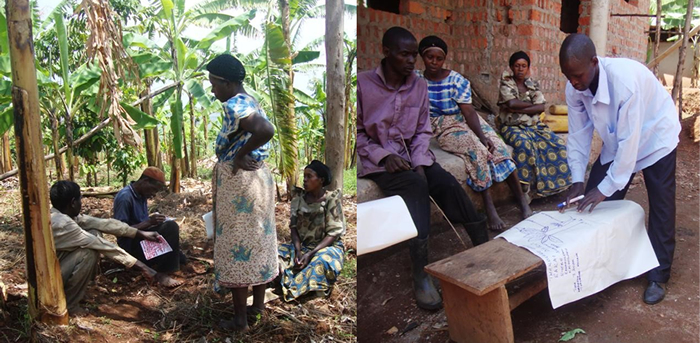
Farmers planning/sharing water management innovations for their gardens
The training program employed a number of approaches to guarantee efficiency and effectiveness while executing the prescribed assignment. The program started with development of simple training manuals and materials to guide the training. A training program was also prepared, discussed and agreed between KACODEP and the trainers.
During training sessions, the trainers adopted various training approaches to stimulate active participation among participants. Each training started with an introduction session through which participants were requested to introduce themselves by names, farmer groups they belong to, as well as sharing one’s most interesting and frustrating moments encountered during their involvement in the coffee business. Participants were also requested to highlight their expectations and fears as part of the introduction sessions.
The objective of the introduction exercise was to create a favourable learning environment and set the ground for the training. Power point presentations and other participatory approaches were employed. Group discussions and presentations were also applied as part of the methodology.
Outcomes for other UNDF Members to learn from
The project was a continuation of Kagera Trans boundary Agro ecosystems Management Project funded by Global Environmental Facility (GEF) through FAO Uganda. The Watershed Management system continued to build values of the Farmer Field School (FFS) approach. Watersheds in Kakuuto Sub County and Katongero in Kyebe Sub County greatly contributed to the preservation of Bukoola River and Kagera that feed into the Nile. KACODEP has been equipped with training tools and materials like the irrigation systems and plans are underway to do more trainings in best practices.
The active involvement of all key stake holders in all stages of the project has instilled a sense of ownership of the project which is essential for sustainability. There is evidence of enhanced project ownership especially by women and youth with support and commitment from both the community and district leaders who have embraced this a sustainable practice to improve lives of the communities. KACODEP members can now mobilize resources through conventional channels: Government, Private Sector and Civil Society Organizations.
Linkages have been done to other locally funded farm activities and programs such as Operation Wealth Creation. The farmers can now sustain activities even after the end of the funding for this particular project.
The project has led to improved production and productivity of coffee as a long-term value chain and short-term value chains of horticulture (fruits such as passion fruits, pineapples) and vegetables.
Value-added ready to drink MASAKA coffee
There is evidence of improved household income among the trained farmers due to more sustained production and sale of high-quality coffee and horticulture products.
The project has led to reduced post-harvest losses of coffee and horticulture products through inculcating the practice of good post-harvest handling practices and value addition. Farmer groups have taken initiative to do value addition to coffee; giving birth to new products on the coffee market such as ready to drink coffee brands of KACODEP Coffee and MASAKA Coffee.
There is improved farmers’ financial discipline through adoption of financial management practices. Farmers can now save and re-invest their savings to expand their agri-business practices along the value chain of coffee and horticulture farming.
Overall, the project taught farmers “how to fish” through knowledge and skills transfer where the acquired knowledge and skills by the farmers will go a long way in having positive mind-set after transition of the project. Gaps found have formed another proposal that is being marketed and discussed with prospective donors. Other resources mobilization methods that do not necessarily fall into the mentioned methodology such as seeking for social cooperate support from companies will also be prioritized.
Authors: Mathias Mulumba, National Technical Support Expert - Uganda Fred Ssendege, Coordinator KACODEP
Uhai Lake Forum (ULF) - a member organization of the Kenya Nile Discourse Forum (KNDF) is implementing a Baseline Emission Inventory and Access to Energy Assessment Study for Kisumu County, Kenya. The study is to build capacity of the County Government of Kisumu officials, equipping them with skills to check / analyse greenhouse emission within the County, and come up with measures on how to control the same.
The overall objective for the study is to develop a baseline emission inventory for Kisumu County. Specifically, the study is to identify all sources of sectorial Green House Gas (GHG) emission within Kisumu County as a territory and Institution. The study will also model Kisumu County Baseline Emission Inventory and also build capacity of Kisumu County technical staff on developing and updating Green House Gas emission inventory and carbon accountability for projects.
To ensure an objective strategic orientation for Kisumu County to mitigate GHG emissions within the county’s institution and jurisdiction by 2030 and 2050, modelling of the BEI will be implemented under two scenarios namely: Business as Usual scenario (BAU), and Voluntary & Optimistic Scenario (SEACAP). Emission reduction targets shall consider Kenya’s Intended National Determined Contribution (INDC) and follow the JRC emission reduction characteristic.
Knowledge and skills from the study will be transferred to the County Technical staff through training.
The study will assess access to Energy, and develop indicators, where unavailable; assess energy for Clean Cooking, heating and electricity within households, public buildings and within micro and informal enterprises; develop baseline Energy consumption and production inventory within Kisumu County Jurisdiction; and also develop gender focused consumer inventory for sectorial energy access.
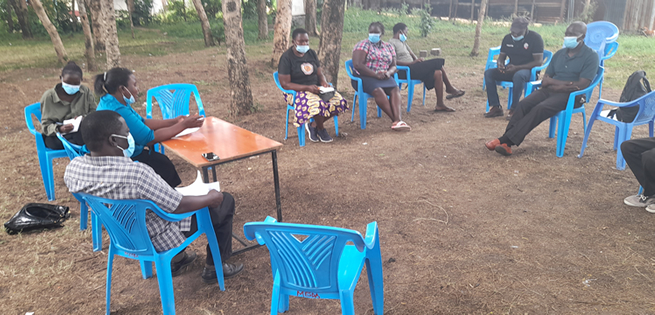
ULF staff in a focus group discussion with community members in Muhoroni Sub-County
Devising and implementing a sustainable energy and climate action plan is a challenging and requires collaboration and coordination between all stakeholders.
ULF in partnership with county government of Kisumu department of Environment, Natural Resource, Water and Climate Change organized a stakeholder engagement workshop; and interactive presentations on the Overview of the baseline emission inventory, Access to energy assessment and Stakeholder engagement strategies were delivered. Additionally, the platform provided space for general discussions, feedback and questions & answer session, and a sectorial breakout session for all stakeholders in the project.
The workshop aimed at making sure that stakeholders understand the study in general, their roles in the study, data requirements from their organizations, and also consent to sharing their organizations/institutions data for the study.
Stakeholders agreed to disclose relevant data and also promised to work closely with their stakeholders to avail the required data for the study. The agreed to participate in the subsequent SEACAP processes.
Overall, beyond the stated responsibilities and expectations them, the stakeholders' active participation and their expression of satisfaction at the end of the workshop was a validation of their unwavering support and contribution to the study.
Ultimately, the project is a leaping step forward into making informed decisions, and getting government authorities directly involved into the fight against environmental pollution in Kisumu County of Kenya.
By Mark Omondi Project Manager, Uhai Lake Forum Email: This email address is being protected from spambots. You need JavaScript enabled to view it. / This email address is being protected from spambots. You need JavaScript enabled to view it.
"Many dimensions of data is missing to effectively support inclusive policy formulation. It is the duty of Civil society to map that data. That is the way NBD gives back to the countries; We are not part of conflicts, but part of a win-win solution" Prof. Muawia Hamid SHADDAD
Data is an integral part of every sector in the global economy - Civil Society inclusive. One of NBD's core objectives of Influencing inclusive policy development for equitable utilization and sustainable management of Nile Basin resources highly relies on knowledge and information from communities, and specifically the indigenous grassroots people. Collecting, synthesising, and presenting of reliable, and inclusive citizen science data like any other data requires skilled personnel.