TPL_YOOTHEME_SKIP_TO_MAIN_CONTENT
Les orages ont causé des inondations  et chavirements des bateaux

Opinion sur les Catastrophes Liées aux Changements Climatiques en RD Congo

Etant donné que les conditions pluviométriques connaissent une affectation à la baisse, il faut envisager essentiellement le degré d’urbanisation dans l’avenir pour pouvoir se prononcer sur le risque d’inondation future dans les fonds de vallées.

Or, si rien ne change dans la politique d’urbanisation, notamment les initiatives privées de morcellement de terrain, il va de soi que l’urbanisation contribuera à l’extension de la ville, mais également à l’intensification de l’urbanisation à l’intérieur de la ville, les deux augmentant encore largement les débits de ruissellement et ensuite les inondations.

Il est à prévoir que la pluie efficace pour produire le ruissellement et l’inondation qui l’accompagne et qui est de l’ordre de 70 mm en 2 heures et 30 minutes avec une récurrence de 2 à 3 ans  sera moins importante dans l’avenir à la suite de l’imperméabilisation du sol consécutive à l’urbanisation sans cesse croissante comme le souligne le chercheur congolais Muhindo Sindani. Ces deux derniers mois des pluies torrentielles ont causé des dégâts énormes sur la ville de Butembo, Bukavu et Uvira (ci-dessous les photos montrent la situation vécue à Bukavu (à gauche) et à Uvira (à droite).

Un éveil brutal s’est produit sous l’effet d’une inondation catastrophique intervenue à Uvira dans le mois dernier à la suite d’une pluie diluvienne. On a observé également la montée des eaux du Lac Tanganyika qui ont envahi la ville d’Uvira. Elle a rappelé aux riverains et aux pouvoirs publics l’existence du risque.

Pourtant, les effets ont été durement ressentis du fait de la concentration de biens, des activités et des personnes dans les zones submersibles, bien plus que les décennies antérieures, périodes pendant lesquelles les conséquences n’avaient pas la même ampleur.

L’augmentation des débits de pic du ruissellement collinaire des dernières décennies conduit à une augmentation de la récurrence et de l’ampleur d’évènements où l’apport soudain de grandes masses d’eau dans les vallées dépasse la capacité d’évacuation des fonds de vallées. Ainsi les débordements des lits des rivières s’étalent dans les vallées à fond plat. A cet effet, la ville de Butembo dont une partie importante de sa circonscription est bâtie dans une dépression est aux prises, ces dernières années, avec des inondations périodiques qui rendent les populations de plus en plus vulnérables.

Pour être complet, l’orage qui a provoqué les écoulements et inondations du 6 octobre 2009 était également accompagné de coups de vent assez forts. Cinq pirogues ont chaviré sur le lac Kivu.

Jean-Claude

 Les propos ci-dessus  nous  ont  été envoyés par notre expert  du changement climatique  en République  Démocratique du Congo, M.  Jean Claude Kyungu.


The NBI Executive Director Prof. Seifeldin Hamad Abdalla (Left) and the NBD Board Chairperson Prof. Shadad (Second - Right) on the Nile day 2020 Comemoration at Friendship Hall, Khartoum - Sudan

Nile Basin Discourse (NBD) at Nile Day 2020, Khartoum – Sudan

On the 22nd February 2020, ten Nile Basin Countries met in Khartoum - Sudan to Commemorate the Regional Nile Day. The 14th Nile Day celebrations organized by Nile Basin Initiative (NBI) and hosted by the Republic of Sudan brought together various stakeholders, Development Partners, delegates from NBI member countries and the general public.

The theme for this year's celebration was: “Joint investments on the Nile for Regional Transformation”.

Nile Basin Discourse (NBD) as a key Stakeholder of the NBI participated at this event; the Sudan Nile Discourse Forum, the NBD Board, and the NBD Secretariat staff represented the NBD family on this occasion.

Summary of Remarks Made By the NBD Board Chairperson at Nile Day 2020, Khartoum – Sudan

At the event, the NBD Board chairperson Prof. Muawia Hamid Shaddad, delivered a statement on behalf of the NBD family. In his address, he reiterated NBD’s commitment to cooperating with NBI through the promotion of dialogue, awareness and consultation among others. He outlined NBD’s achievements towards trans-boundary cooperation through capacity building, outreach, awareness promotion, consultation, and communication at National and transnational programs, in focus of joint investments. He also informed participants that NBD has focused on integration, inclusion, and collaboration on waters of the Nile ever since its establishment.

Prof Shaddad said that currently, the main objective has been to enhance, and draw responses to critical issues across the riparian countries towards achievement of transformative agenda 2030 in development and cooperation.

While concluding the remarks Prof. Shaddad reiterated NBD’s commitment to working closely with NBI centers and governments of Nile Riparian States to foster cooperation, and support initiatives that lead to joint investments of Nile Subsidiary action programs. Click here to get the full statement.

About NBD

Nile Basin Discourse (NBD) is a network of Civil Society organization established in 2003 with the support of World Bank and other Development partners to strengthen civil society participation in Nile Basin (NBI) development processes, projects, programs, and policies. The NBD has evolved into an independent network of over 600 member organizations throughout the Nile basin. Member organizations are local and national CSOs/NGOs working on a range of issues relevant to Nile cooperation; including environmental conservation, agriculture, energy, gender equity, livelihoods, poverty reduction, and others. The CSOs/NGOs are members of chapters at national level referred to as Nile Discourse Forums (NDFs) established in each of the eleven riparian states. The NDFs in turn form the NBD Network, coordinated by a regional Secretariat based in Entebbe, Uganda.
For more information visit our website at www.nilebasindiscourse.org

#OneNileOneFamily
Women group leaders in a planning session ahead of the Water, Sanitation and Hygiene Learning Caravan

Uganda: Mabamba Bay Women Groups Committed to Improving Water, Sanitation and Hygiene in their Community

Women in Mabamba Bay on the shores of Lake Victoria in Uganda expressed their commitment to improving Water, Sanitation and Hygiene (WASH) in their community. They also showed high inspiration and commitment to promote environment-friendly development practices in their area. The commitment came after the Learning Caravan facilitated by NBD and other partners from November 2019 to January 2020. The learning caravan provided several women groups the opportunity to share knowledge and best practices from neighboring households on issues related to WASH and environmental management.

In 2018 NBD and IHE Delft signed the partnership framework agreement for the project entitled “Women and Water for Change in Communities” a 2-year project funded by the Coca Cola foundation. Read details of the project from the UN-IHE website HERE
Overall, the project was implemented at Mabamba Bay area in Uganda, and Mara river basin in Tanzania. Under this partnership framework, NBD conducted trainings on “Empowerment of Women and youth as Climate Resilience Champions”, targeting selected women and youth that are capable of influencing their communities for both Tanzania and Uganda.
 
As a follow-up to the 2018 training; from November 2019 to January 2020, NBD in partnership with Network for Water and Sanitation (NETWAS) facilitated communities from three villages of Mabamba Bay (Lubya, Nakasozi and Ziba) to hold a Community Learning, Knowledge development, and best practice Exchange caravan in Uganda.

The major objective of the caravan was to enable the communities to share, learn knowledge, and best practices about good WASH and environmental management from each other so that knowledge and best practices are duplicated within the households, villages, and beyond.

Through house to house visit, participants of the learning caravan were able to see Hygiene and Sanitation facilities in the neighborhoods and, learned about best WASH practices as explained by the owners of the facilities and the expert facilitators who facilitated the caravan.

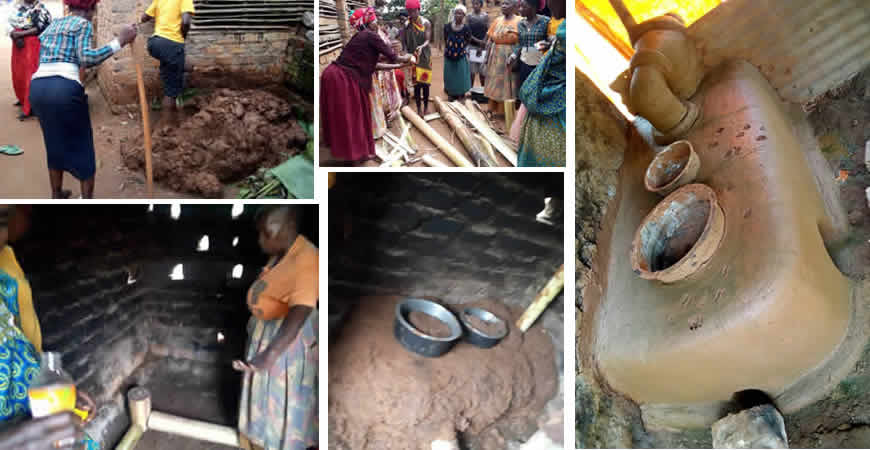
Women leaders from Mabamba also toured Katosi Model Village in Mukono as an exchange visit, from where they learned on how to make improved energy cooking stoves.
Description Description
Women learning and actively participating in the building/making of modern and energy efficient cooking stoves - All stages From start to finish


Learning by doing:  Results talk from the ground

Around 100 women and men from Mabamba Bay area participated in the caravan.  Ms. Irene Namubiru who chairs the Mabamba Women Group says that they learnt a lot about WASH under NETWAS coaching including the making of energy efficient cooking stoves.

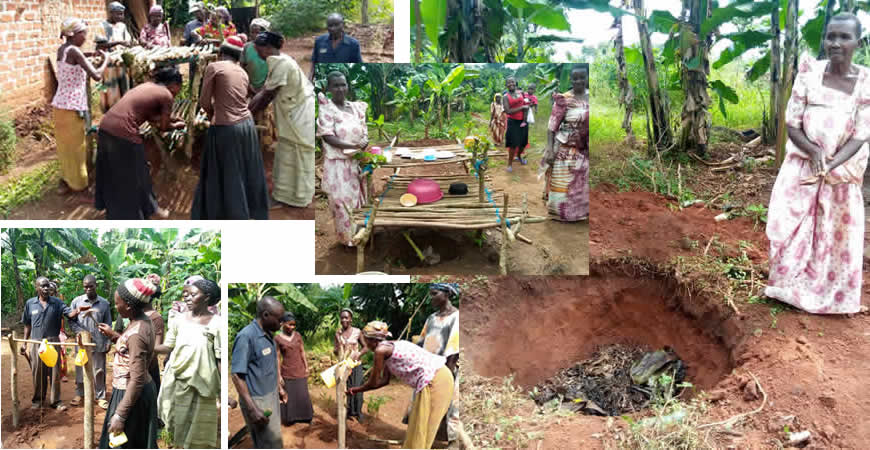
After the learning caravan, women from three villages managed to construct 8 latrines, 35 utensils drying racks, 75 tip-taps for hand washing, 26 energy cooking stoves, and dug 52 rubbish pits.

Description Description
Participants of the WASH learning caravan during a hands on exercise on digging rubbish pits, making utensil drying racks, and making of tip-taps to facilitate washing of hands after use of Latrines
As a model and strategy of continuity of the program, women groups have also started recruiting men, youth, and children to be part, learn and carry on the knowledge in their communities.

The learning caravan exercise was crowned with a one day results/experience sharing meeting of groups from different villages.
Local council leaders and representatives of the local government graced this occasion and expressed their gratitude for such exciting but also educative arrangement that will benefit these communities not only today but through the years to come. 

At the same gathering, children of Mabamba bay community presented a poem on WASH and conservation of the environment as in the video on the right >>

The women community highlighted a few challenges:
1)     They expressed the challenge of lack of access to safe water despite their closeness to a large water body. The search for safe water at distant places puts the girl child at great risk since they are the most involved in fetching water in their communities. They community welcomes any opportunity geared towards solving the water crisis in this area.

2)    The current women groups are self support initiatives to boost family self support. The groups have started venturing into Savings And Credit Co-Operative (SACCO) initiatives but are short of funds to have these SACCOs grow and evenly support their membership.

3)    They need capacity building on Credit and Savings in order to better manage these the credit schemes/SACCOs

4)    The women also requested to be facilitated to have more exchange visits even in other countries where NBD operates so as to share experiences, but also carry on the knowledge exchange and self learning program.